

Welcome to Module 5, The Acquisition Blueprint. In the last module, we did the most important work in your business: we forged your Message and your Offer.
Now, it’s time to put that message in front of your target market. This is Lead Generation. But this is also where most entrepreneurs get lost, focusing on the wrong thing. This lesson will give you the clarity to avoid that trap.
Think of lead generation like fishing. To be successful, you need two things:
The Bait (Your Message): This is what actually attracts the fish. It must be something the specific fish you want to catch (your market) finds irresistible.
The Fishing Rod (Your Method): This is the tool you use to get the bait into the water. It could be a simple hand line, a fancy fly-fishing rod, or a giant commercial net.
Here is the critical mistake most people make: They spend all their time and money buying new fishing rods, while using bait that the fish hate.
It doesn’t matter how expensive or sophisticated your rod (your lead gen method) is. If the fish don’t want the bait (your message), you will never get a bite. The success of your fishing trip is determined almost entirely by the quality of your bait.
Your lead generation method is simply the vehicle you pay for—with time or money—to put your message in front of your market.
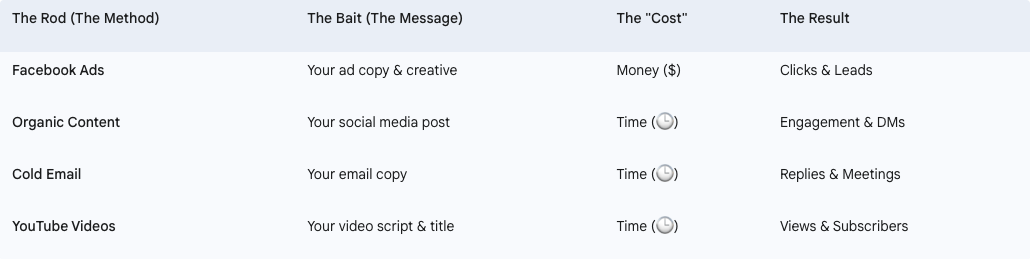
No matter which rod you choose, the result is always determined by the bait.
Let’s look at the math with ads. When you run ads, you pay for impressions (views). Let’s say you pay $30 to show your ad to 1,000 people. That cost is relatively fixed. What changes is how people react to your message.
Bad Bait (Weak Message): You pay $30, 1,000 people see it, and 1 person clicks. Your Cost Per Click (CPC) is $30.
Average Bait (Okay Message): You pay $30, 1,000 people see it, and 10 people click. Your CPC is now $3.
Irresistible Bait (Great Message): You pay $30, 1,000 people see it, and 30 people click. Your CPC is now just $1.
You paid the same amount to cast your line. The quality of your bait determined the result. The same is true for organic content. You can spend 5 hours creating 5 posts. If the message is weak, you might get one response. If the message is powerful, you might get 30. The “cost” in time was the same; the message determined the outcome.
Stop blaming your fishing rod. It’s almost always the bait.
When you’re first testing your bait, there are two primary ways to do it.
Organic (Fishing from the Shore): This involves spending time on activities like posting content or sending direct messages.
Pro: You get rich, qualitative feedback. You can see the fish swim up, look at your bait, and swim away. Sometimes, they’ll even tell you why they didn’t bite (“I’m not interested because…”). This helps you improve your bait quickly.
Con: It’s time-consuming and has limited reach.
Paid Ads (Fishing with a Trawler Net): This involves spending money to show your message to a huge number of people at once.
Pro: You can test messages at a massive scale.
Con: The feedback is binary—you either caught fish or you didn’t. You rarely know why. It also requires a larger sample size (and therefore more money) to get reliable data.
Recommendation: When you’re first starting and iterating, it’s highly suggested to start with organic methods. Fishing from the shore allows you to learn much faster with less financial risk.
It’s time to get your line in the water. This exercise is about creating a clear, simple plan to test your message. Using your interactive “First Cast: Lead Gen Action Planner”
Choose Your Fishing Spot: Based on your resources, will you start with Organic (Time) or Paid (Money)?
Define Your First Cast: In your notebook, write down your specific plan using this formula:
“This week, I will test my Level 4 message by [Doing a Specific Action] [A Specific Number of Times].”
Examples:
“This week, I will test my Level 4 message by sending 20 personalized DMs on LinkedIn.”
“This week, I will test my Level 4 message by posting 3 pieces of content focused on that message.”
“This week, I will test my Level 4 message by running a $50 ad to a targeted audience.”
This commitment is your first step to discovering the bait your market finds irresistible.

