


Welcome to Lesson 4. In our last lesson, we learned how to construct an offer by turning your client’s roadblocks into your solutions.
Now, we answer the question: “How do we deliver on that offer in a way that creates thrilled clients and glowing testimonials?” This is the art of Fulfilment.
Think of your client’s journey as a road trip.
Point A: Their current, painful problem.
Point B: Their desired situation.
Your Offer: The GPS navigation system that promises to guide them from A to B.
A “good” GPS system (and a good fulfillment process) is judged on three simple criteria, which are the three pillars of world-class fulfillment: Scope, Simplicity, and Speed.
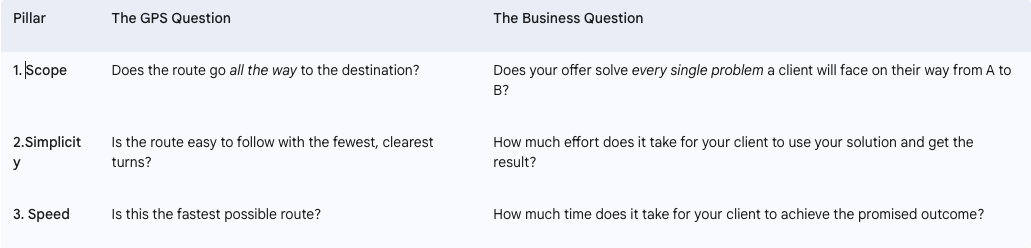
This is the most important pillar. If you promise to get someone to a destination, your route must cover the entire journey.
Incomplete Scope: You promise to “help them get clients” but only show them how to run Facebook ads. You’ve dropped them off halfway because getting clients also requires lead nurture, sales, and onboarding.
Complete Scope: Your promise matches your delivery. If you only teach ads, you promise “help you get leads with Facebook ads.” If you promise “help you get clients,” your fulfillment covers the entire process from lead to signed contract.
It is always better to promise a smaller, well-defined outcome and deliver on it perfectly than to promise a huge outcome and fail to cover the full scope.
A great offer makes the journey as effortless as possible for the client. This usually means you, the business owner, have to do the heavy lifting of creating systems and resources.
Complicated for Client: “Here’s a guide on Facebook ads. Go figure it out.” (Simple for you, hard for them).
Simple for Client: “Here are the exact ad templates, the headline formulas, the email sequences, and the call scripts you need.” (Complex for you to create, simple for them to use).
A world-class offer removes the burden of complexity from the client.
All else being equal, faster is better. People want results as quickly as possible.
Blockbuster: To watch a movie, you had to drive to a store, browse, pay, and drive home.
Netflix: You click a button.
Netflix didn’t change the outcome (watching a movie), but it won by dramatically increasing the Speed and Simplicity of the fulfillment.
When you’re just starting, it’s highly recommended to begin with a high-touch delivery model like one-on-one coaching or a Done-For-You (DFY) service.
Think of it this way:
The 4×4 (1-on-1/DFY): It’s rugged, all-terrain, and can handle any unexpected obstacle. It’s perfect for exploring and mapping out the path to your client’s destination for the first time.
The Race Car (Automated Course): It’s incredibly fast and efficient on a perfectly paved, well-known track. But if you take it on an unpaved, unknown road, it will crash and burn.
Starting with a high-touch model allows you to:
Discover the Full Scope: You’ll uncover every single roadblock your clients face because you’re on the journey with them.
Maximize Simplicity & Speed: It’s much easier and faster for a client to be guided directly by you than to navigate a complex program alone.
Iterate Instantly: If you realize a part of your process is broken, you can fix it with your very next client. You can’t do that with a pre-built, automated course.
Only once you have a proven path that consistently gets clients to their destination should you consider building the racetrack for your race car.
Let’s audit your current or planned fulfillment process. Using the Interactive “Fulfilment Audit Tool”, rate your delivery on a scale of 1-5 for each of the three pillars.
Scope Score (1-5): How completely does my solution solve every problem between my client’s Point A and Point B?
Simplicity Score (1-5): How much effort does my client have to put in to get the result? (1 = A lot of effort, 5 = Almost none).
Speed Score (1-5): How quickly does my client achieve the promised outcome compared to other alternatives?
The pillar with the lowest score is the first area you need to improve in your fulfillment process.