


Welcome to the final lesson of Module 4. We’ve built your Messaging, your Offer, and your Fulfillment plan. Now we address the final, crucial pillar of your Promise Package: Price.
This lesson will challenge everything you think you know about pricing and show you why charging more is often the key to building a better business and getting better results for your clients.
Fundamentally, people buy if they believe the value of what they receive is greater than the cost they pay. But there’s a catch, which we can understand with the “Price Thermometer.”
Imagine a thermometer that measures your market’s Belief in your promise.
Too Cold (Low Price): You offer a life-changing transformation for $2. The value seems to massively outweigh the cost, but it’s “too good to be true.” The prospect gets suspicious, their belief plummets, and they don’t buy. The price is so low it signals a lack of value.
Too Hot (Absurd Price): You offer a simple PDF guide for $20,000. The cost massively outweighs the perceived value. Belief is zero. They don’t buy.
The Sweet Spot (Premium Price): You offer a life-changing transformation for $5,000. The price is significant, which signals that the value must also be significant. It feels like a serious investment for a serious result. It’s believable. This is the zone where high-ticket sales happen.
If you have followed the steps in this course to build a powerful message and a comprehensive offer, you must charge a premium price. A low price will actively work against you by making your incredible promise unbelievable.
Charging a high-ticket price ($2,000, $5,000, $10,000+) isn’t just about making more money. It unlocks four critical advantages for your business.
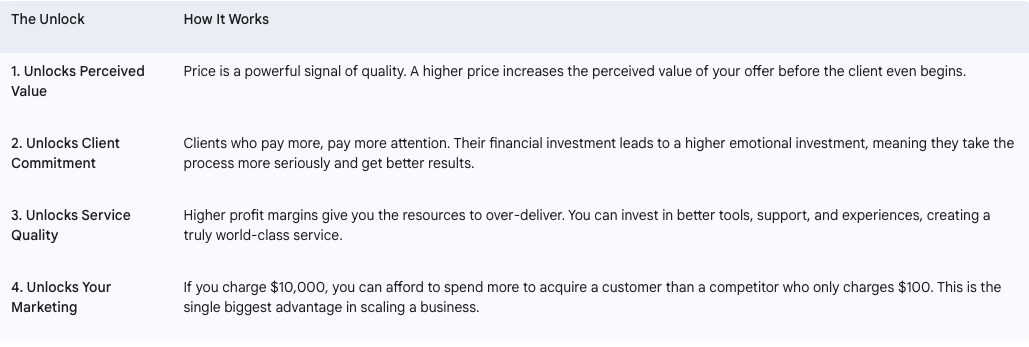
Let’s address the common fears that hold entrepreneurs back from charging premium prices.
Belief #1: “It’s easier to sell something cheaper.”
Reality: It’s not 10 times easier to sell a $100 product than a $1,000 product. But you need 10 times the customers to make the same revenue. The effort is often far greater for lower-priced offers.
Belief #2: “By charging less, I can help more people.”
Reality: You may sell to more people, but you won’t help as many. Low-paying clients are often the least committed and get the worst results. It’s better to help 10 people achieve a life-changing result than to sell to 200 people who get no result at all.
Belief #3: “No one would pay $5,000 for what I do.”
Reality: This is a symptom of a weak Message or Offer, not a pricing problem. People don’t pay $5,000 for “a diet plan.” But they absolutely will pay $5,000 to “overcome low energy so they can have the vitality to play with their kids.” Your job isn’t to lower the price; it’s to increase the value of your offer until the price feels like a bargain.
It’s time to build unshakable confidence in your price. This exercise will help you logically justify your premium fee.
List Your Offer Components: Using the Interactive “Value Stack Calculator”, list every single component of your offer (the solutions you built in the “The Iteration Matrix Tool”
Examples: “Module 1: The Sustainable Eating Plan,” “6x 1-on-1 Coaching Calls,” “The Accountability System.”
Assign a Value to Each: Next to each component, assign a conservative, real-world value. What would someone pay for just that one piece? Be honest.
Calculate Your Total Value: Add up the value of all your components. This is your “Total Stacked Value.”
Set Your Price: A common rule of thumb for an irresistible offer is to set your price at roughly 1/10th of the Total Stacked Value. (e.g., If your total value is $50,000, a $5,000 price point is a fantastic deal).
You now have a logical, value-backed reason for your price. This is not only a powerful way to present your offer to clients, but it’s the ultimate tool for building your own conviction.